
“Your Future Is Today”
Quito is situated on a plateau within the Guayllabamba River basin on the eastern slope of a periodically active volcano, Pichincha. Traces of human occupation in the area date back to 8000 B.C, with major indigenous settlements by the Cotocollao and Inca civilizations. When the Spanish arrived in 1526, the Incas were embroiled in a civil war led by two brothers in opposition after the death of their father who had been ruler. With military forces decimated, the Spanish conquest of Quito was relatively easy and many of the original buildings and churches from this timeframe exist today. The city now offers the best-preserved and least-altered historic centers in Latin America, making it a UNESCO World Heritage site.
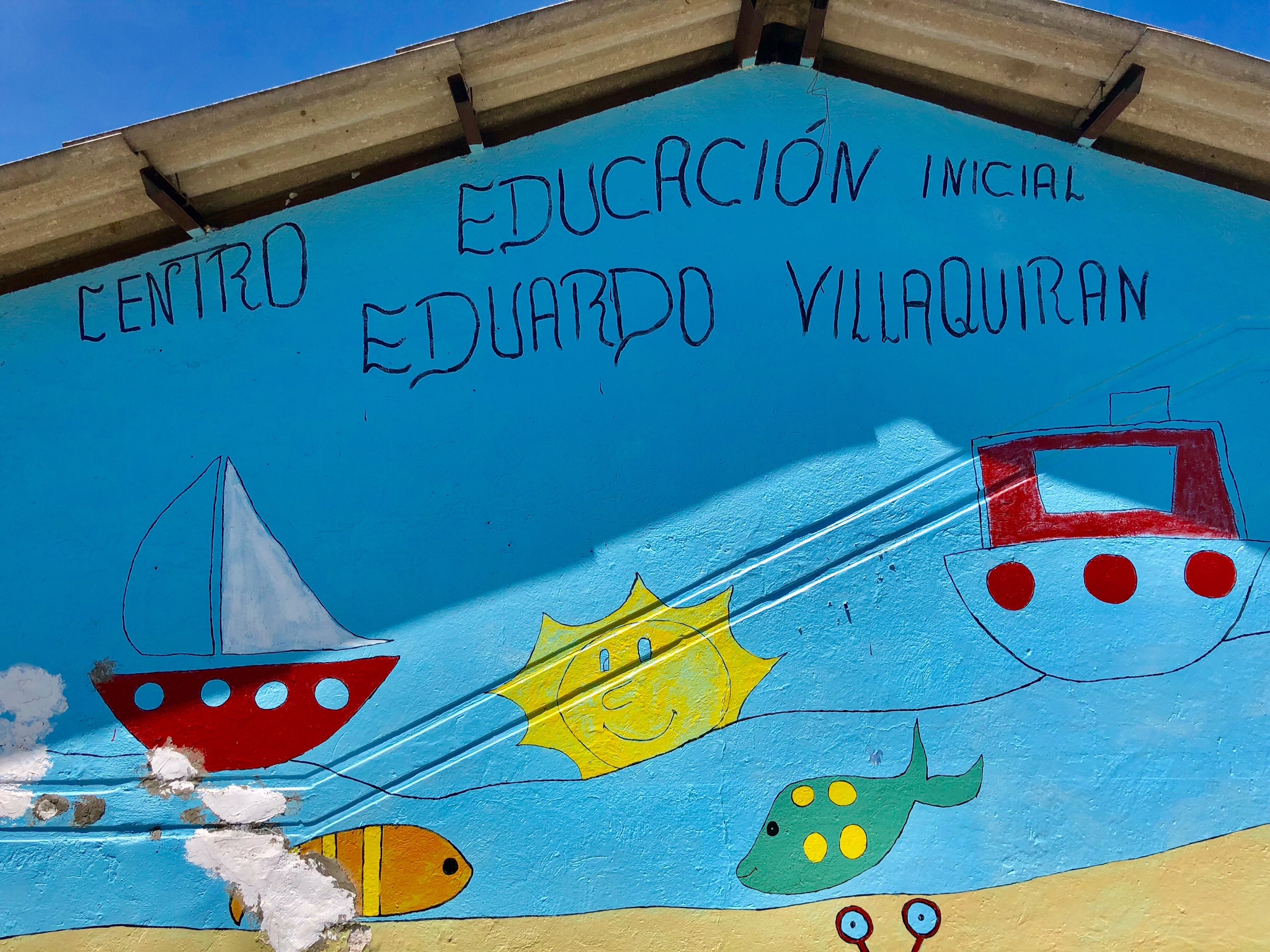
As with most communities, the downtown core is populated first and the outskirts are developed as the city expands. In Quito, when the flat ground was fully developed, they built neighborhoods into the steeply sloping hillsides (especially marginal land when you consider these “hills” are the downslope of a volcano). This is where the poorer inhabitants of Quito live. Our second volunteering project has been in a preschool for ages 3-5 in one of these neighborhoods, Toctiuco, called “Eduardo Villaquiran Centro de Educacion Inicial”.
The school is built into the steep slope like all of the surrounding buildings, and comprised of two separated classrooms connected by a series of concrete terraces. The view is absolutely spectacular and on clear days you can see the volcanoes of Cotopaxi to the south and Cayambe to the north. However, this vista becomes sobering when you then notice the high-voltage transmission lines running over the chain link fence topped with barbed wire on the edge of the property. Purposely broken shards of glass are additionally mortared on top of any exposed concrete surface to keep out intruders.
Erin and I have separated into each of the classes with either Connor or Keegan joining us. With 25 students for each teacher, the assistance has surely been appreciated (even if we’re just helping keep the peace). The kids spend much of their classroom time learning numbers and letters, writing their names, and practicing colors, shapes, and sizes. Most activities are hands-on to engage short attention spans, often working with paint, glue, and clay to reinforce the daily concepts with a tactile experience. After lessons, the children line up to wash their hands and prepare for snack time. Snacks range from cookies, crackers, fruit, yogurt, and bread to more elaborate meals including rice, beans, eggs, and (my personal favorite) salchipapa. To finish the morning, the kids brush their teeth then head into the terraced, concrete jungle for recess.
Our bad Spanish coupled with the preschoolers’ quiet voices and accents make for some entertaining dialog. We’ve encouraged our boys to pose lots of simple questions — what color is this, is she your friend, do you like your snack, and the versatile “por que” (why)? — to engage the children in conversations even if they have no idea what the response means. I spend my recess time watching the kids interact with one another. (Without the distraction of understanding what they are saying or needing to form an intelligent response, it makes for amazing observation of body language and how they are communicating to infer the what.) My summation: kids are kids, regardless of their country, culture, or language. They like to share during snack time. If someone steals a ball, they protest, grab back, and sometimes retaliate. Maximizing individual self interest is job #1. But this age is also the start of developing peer groups and social networks. We can identify the introverts and extroverts, the “trouble makers”, those who the other students respect and listen to, and those who are (unfortunately) most frequently taken advantage of.
Our boys are enjoying their time as they feel they can do more with the children. Connor is kind and patient in the classroom and always looking to incite a game of tag on the playground. Keegan has taken a bit longer to warm up (it’s his nature), but is now the first one to sit down at a table of students and model good behavior for whatever activity is requested of the class. In recess earlier this week, he encountered a kid who was sad for being left out of whatever game the others had contrived. Keegan sat with him at the bottom of the slide and overcame the language barrier by just smiling and acting goofy to cheer him up. It was a proud moment watching such simple kindness.
Despite corruption that has plagued its government, Ecuador has made investment in early childhood education a priority in recent years. Half-day preschool is free for kids 3 and up, with uniforms and snacks provided for kids who can’t afford them. Although the coloring could still use some work (see below), these early learning opportunities are invaluable and peer experiences formative for the rest of their lives. Perhaps the U.S. should take notice; our future is worth it.


 Perrin Family Adventures
Have enjoyed your reading about your adventures. Take care. Safe travels.
LikeLike
Thanks Sue. Crazy to think we’ve been here for 5 weeks, with only 2.5 weeks to go. Keegan astutely pointed out “2/3 of the way through our trip”. Hope all is well!
LikeLike